
Setting Up a HIPAA-Compliant Home Health Office
Working remotely as a licensed Registered Nurse carries federal regulatory responsibilities that do not apply to standard corporate remote workers. Under the Health Insurance Portability and Accountability Act (HIPAA) Security Rule (45 CFR § 164.530), healthcare practitioners must maintain administrative, physical, and technical safeguards to ensure the confidentiality, integrity, and availability of electronic protected health information (ePHI).
Failing a remote HIPAA audit can disqualify an applicant during onboarding or lead to immediate employment revocation. Configuring your workspace prior to interviewing demonstrates seasoned professional readiness to clinical hiring managers. Search verified remote openings across our Master Remote RN Job Directory.
Physical Workspace Isolation & Privacy Safeguards
Your clinical home workspace must be an isolated, dedicated room with four solid walls and a lockable door. Open-concept dining rooms, kitchen islands, or shared family living areas are strictly barred by commercial health plan compliance policies.
- Sightline Protection: Computer monitors must be positioned so that screens cannot be viewed through windows or doorways by family members or visitors. Privacy filter screens are strongly recommended.
- Audio Privacy & Device Removal: All consumer smart speakers (Amazon Echo, Google Home, Apple HomePod) and smart televisions with microphone listening enabled must be completely removed from the workspace.
- Physical Security: Any printed documents containing patient identifiers must be immediately shredded using a cross-cut shredder (P-4 security standard) or secured in a heavy lockable filing cabinet.
High-Speed Ethernet vs Wi-Fi Security Requirements
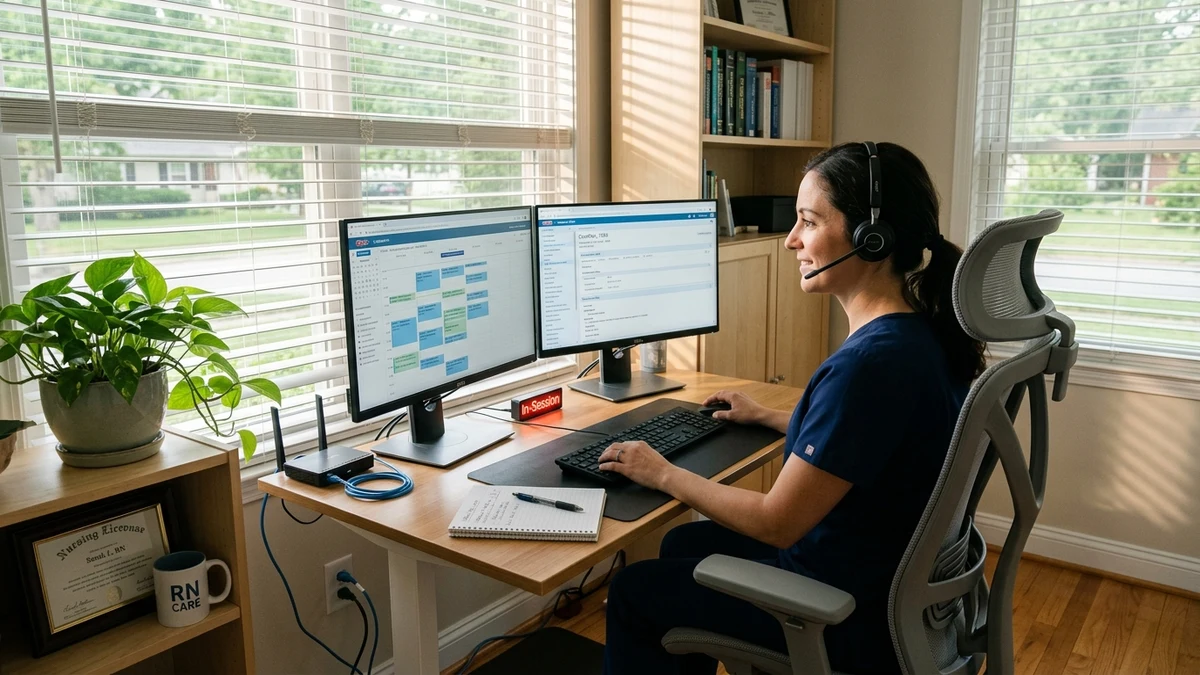
Health systems and insurance payors almost universally require a direct, hardwired Cat6 Ethernet cable connecting your corporate computer to your home internet router. Standard home Wi-Fi is frequently rejected for two vital operational reasons:
- Packet Loss & VoIP Call Quality: Wi-Fi suffers from intermittent radio interference, causing jitter and dropped calls during telephonic patient triage and physician peer-to-peer reviews.
- Security Vulnerabilities: Hardwired connections eliminate the risks of Wi-Fi de-authentication attacks and rogue access points, ensuring an impervious pipeline into the employer's encrypted VPN.
- Minimum Bandwidth Standards: A minimum of 50 Mbps download and 15 Mbps upload is standard to support simultaneous EHR navigation, softphone telephony, and video conferences.
Day-to-Day Realities of Working From Home as an RN
Stepping away from hospital bedside shifts transforms your physical and emotional well-being, eliminating chronic back pain, 12-hour standing fatigue, and night-shift circadian disruption. However, remote nursing introduces distinct professional dynamics that require proactive personal adjustment.
Managing Call Volume Metrics and Productivity Quotas
In corporate healthcare operations, productivity is tracked mathematically. In telephonic triage, systems log average handle time (AHT), call wrap-up time, and adherence to scheduled phone queue availability. In Utilization Review, nurses are expected to complete 18 to 25 chart reviews per shift.
Succeeding in this environment requires disciplined time management, rapid typing proficiency (minimum 50–60 words per minute), and mastery of clinical software keyboard shortcuts. Nurses who thrive establish structured hourly routines and utilize ergonomic standing desks to maintain physical vitality throughout the workday.
Preventing Isolation: Maintaining Peer Connection Outside the Hospital
One unexpected adjustment for bedside nurses is the sudden absence of hospital unit camaraderie—the shared laughter in the breakroom and immediate physical backup during clinical emergencies. Remote nursing is inherently quieter and more solitary.
Top remote healthcare employers bridge this gap using internal collaboration channels (Microsoft Teams, Slack) where clinical teams discuss complex cases, share clinical tips, and celebrate personal milestones. Engaging in professional organizations like the American Nurses Association (ANA) or the Case Management Society of America (CMSA) further maintains professional networking.
Step-by-Step Bedside Exit Strategy: A 90-Day Transition Timeline
Transitioning safely away from hospital bedside employment requires calculated, strategic execution over a structured 3-month timeline. The following roadmap outlines the exact milestones for a frictionless career transition:
Audit Licensure & Foundation
Verify your multi-state eNLC status using our Licensure Reciprocity Tool. Confirm your license is pristine and unencumbered. Enroll in an online InterQual or MCG criteria familiarization module, or initiate study for the Certified Case Manager (CCM) exam.
Translate Resume & Build Workspace
Rewrite your nursing resume using corporate ATS keywords (risk stratification, utilization review, ICD-10 specificity, HEDIS measures) using our Transferable Skills Translator. Order your Cat6 Ethernet cable, test home internet speeds, and configure a dedicated private room with a lockable door.
Target Applications & Secure Offer
Apply directly to verified enterprise ATS listings (UnitedHealth, Elevance, Humana, Centene) via our Master Remote Job Directory. Prepare for behavioral STAR interviews focusing on autonomous problem solving and digital clinical judgment. Secure your corporate offer and provide professional 2 to 4 weeks notice to your hospital nurse manager.
Frequently Asked Questions About Working from Home as a Registered Nurse
01How do employers verify my home office is HIPAA compliant before hiring?
During the final onboarding phase, employers typically require a signed Home Office Attestation and a virtual video walkthrough. You must demonstrate a dedicated private room with a solid lockable door, absence of smart home listening devices (Amazon Alexa, Google Nest), hardwired Cat6 Ethernet connection to your modem/router, and a physical document shredder or locked file drawer.
02Will I lose my clinical nursing skills if I leave the hospital bedside?
No. While you will no longer practice manual psychomotor interventions (such as placing peripheral IV lines or foley catheters), your diagnostic synthesis, pharmacotherapy knowledge, pathophysiology analysis, and clinical decision-making skills expand significantly in corporate roles like Utilization Review, Case Management, and CDI.
03Can I care for young children while working from home as a remote RN?
No. Accredited healthcare employers require dedicated, uninterrupted focus during shift hours. Corporate telephonic and triage roles involve real-time patient interactions and continuous call queues where background noise is strictly prohibited. Employer contracts specifically mandate dedicated dependent childcare during scheduled working hours.
04What is the typical daily productivity quota for a remote utilization review nurse?
Inpatient concurrent utilization review nurses typically complete between 18 and 25 chart reviews per 8-hour shift, depending on hospital acuity and whether physician peer-to-peer discussions are required. Outpatient prior authorization nurses generally review between 22 and 30 cases daily against established MCG or InterQual clinical algorithms.