Licensure Rules for Remote Registered Nurses: eNLC vs Non-Compact States
Navigating regulatory compliance is the single most critical consideration for Registered Nurses seeking telephonic and remote healthcare careers. Unlike software or marketing professionals who work across state borders without administrative oversight, nurses are governed by individual state nurse practice acts. Failure to understand cross-border licensure can result in unlicensed practice citations, disciplinary reprimands, and immediate employer termination.
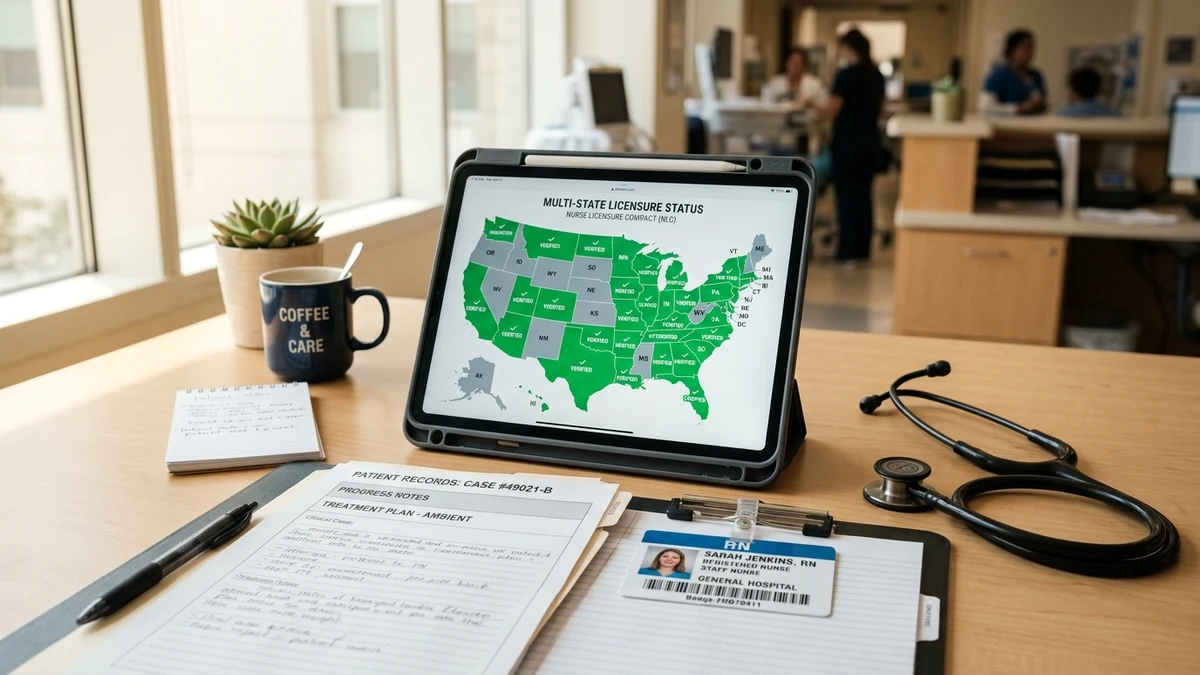
The Enhanced Nurse Licensure Compact (eNLC), established by the National Council of State Boards of Nursing (NCSBN), was designed to remove operational friction for multi-state healthcare systems and digital health providers. By enabling a single multi-state license to function seamlessly across 41+ participating jurisdictions, the compact serves as the primary infrastructure for modern remote clinical employment.
Practicing Across State Lines: Where Must Your RN License Be Held?
In healthcare law, the location of clinical practice is legally defined by the physical location of the patient during the encounter. When an RN in Florida conducts telephonic symptom triage for a caller in Texas, that clinical act is considered to occur within Texas jurisdiction.
Because both Florida and Texas participate in the eNLC, the nurse’s Florida multi-state license legally covers the Texas consultation without requiring an additional Texas license. However, if the caller is traveling through California, the nurse must hold an individual California RN license to legally advise the patient, unless specific emergency interstate reciprocity rules apply.
California, New York, and Single-State Licensure Exceptions
A significant portion of US remote nursing jobs are offered by health systems or commercial payors headquartered in non-compact states. California, New York, Alaska, Hawaii, and Oregon have historically declined or delayed full eNLC enactment, citing state-level regulatory autonomy, public health oversight, and union labor concerns.
To work for major California healthcare groups (such as Kaiser Permanente or Sutter Health) or New York health plans (such as Empire BlueCross), nurses residing elsewhere must obtain licensure by endorsement. Endorsement typically requires fingerprint background checks, verification of transcripts, and Board of Nursing application fees ($150–$350).
Core Responsibilities in Remote RN Roles
Remote nursing is not passive administrative clerical work. It requires sophisticated, independent clinical decision-making conducted without the benefit of physical palpation or auscultation. Remote RNs synthesize electronic health data, subjective patient descriptions, and algorithmic guidelines to safeguard patient outcomes. Compare clinical competencies across corporate fields in our Non-Bedside Specialty Directory.
Direct Patient Telephonic Assessment
In outpatient call centers, triage lines, and virtual urgent care centers, triage nurses systematically interview callers using standardized protocols (such as the Barton Schmitt pediatric protocols and David Thompson adult telephone triage algorithms). Nurses must rapidly recognize red-flag symptoms, differentiate acute emergent events (e.g. dissecting aortic aneurysm vs musculoskeletal thoracic pain), and direct callers to 911 dispatch, urgent care centers, or outpatient primary care follow-up.
- Executing validated telephone triage algorithms within 6 to 9 minutes per call.
- Acoustic assessment of respiratory distress, dysarthria, and cognitive alterations.
- Post-discharge telephonic wellness checks following complex surgical procedures.
Chronic Disease Management & Care Coordination
Working within Medicare Advantage and commercial payor care management divisions, remote case managers oversee complex patient cohorts suffering from multiple co-morbidities (congestive heart failure, COPD, end-stage renal disease, type 2 diabetes). Case managers conduct telephonic medication reconciliation, identify gaps in preventative screenings, and coordinate community social determinants of health (SDOH).
- Bi-weekly telephonic biometric evaluations (blood pressure, blood glucose, daily weights).
- Preventing avoidable 30-day hospital readmissions through outpatient resource mobilization.
- Coordinating durable medical equipment (DME), oxygen concentrators, and home health services.
Minimum Clinical Qualifications for Entry-Level Remote RNs
While remote positions eliminate hospital physical strain, employers maintain stringent experience baselines to ensure clinical safety. The following qualifications represent the universal baseline required by accredited health plans:
A minimum of 2 to 3 years of direct hospital acute care experience (ICU, Emergency, Med-Surg, or Telemetry). Recent acute experience proves familiarity with modern disease trajectories and pharmacotherapy.
A pristine state nursing license free from administrative disciplinary actions, probation, or active board consent agreements in any US jurisdiction.
Demonstrated operational proficiency in major Electronic Health Record software (Epic Systems, Oracle Cerner, MEDITECH) and secure enterprise VoIP telecommunications platforms.
Evaluating the financial benefits of stepping away from the bedside? Use our Remote Net Pay & Commute Savings Calculator to model your true take-home pay.
Frequently Asked Questions About Remote RN Positions
01Where must my RN license be held if I provide telephonic care to patients in multiple states?
Under National Council of State Boards of Nursing (NCSBN) regulatory statutes, nursing care occurs at the physical location of the patient at the exact time of the telephonic or virtual encounter. If you and the patient reside in states participating in the Enhanced Nurse Licensure Compact (eNLC), your single home state multi-state license authorizes practice. If the patient resides in a non-compact state, you must hold an active individual license endorsement issued by that specific state board.
02How do California and New York handle remote nursing licensure for out-of-state nurses?
Neither California nor New York participates in the eNLC compact. Both states maintain strict single-state jurisdiction. Out-of-state Registered Nurses providing care management, telephone triage, or utilization review for patients or facilities located within California or New York must apply for and maintain full licensure by endorsement from the California Board of Registered Nursing or New York State Board for Nursing.
03Can new graduate Registered Nurses get hired into remote RN jobs?
While entry-level remote positions exist, the vast majority of healthcare payors and telehealth providers mandate at least 2 to 3 years of acute clinical inpatient experience. Independent remote triage and utilization analysis require autonomous clinical judgment and intuitive pattern recognition developed through direct bedside patient care.
04What is the Primary State of Residence (PSOR) rule for compact licenses?
Your Primary State of Residence (PSOR) is declared through legal documentation such as a driver's license, state voter registration, or state income tax return. You can only hold one multi-state compact license issued by your official PSOR. If you relocate to another compact state, you must transfer your primary license within 60 days to maintain multi-state privileges.