
$44.50 – $56.00 / hr$92,560 – $116,480 / yr
Evaluate inpatient medical necessity, level of care, and acute admissions using InterQual criteria. Collaborate with hospital case managers and CMS Two-Midnight guidelines.
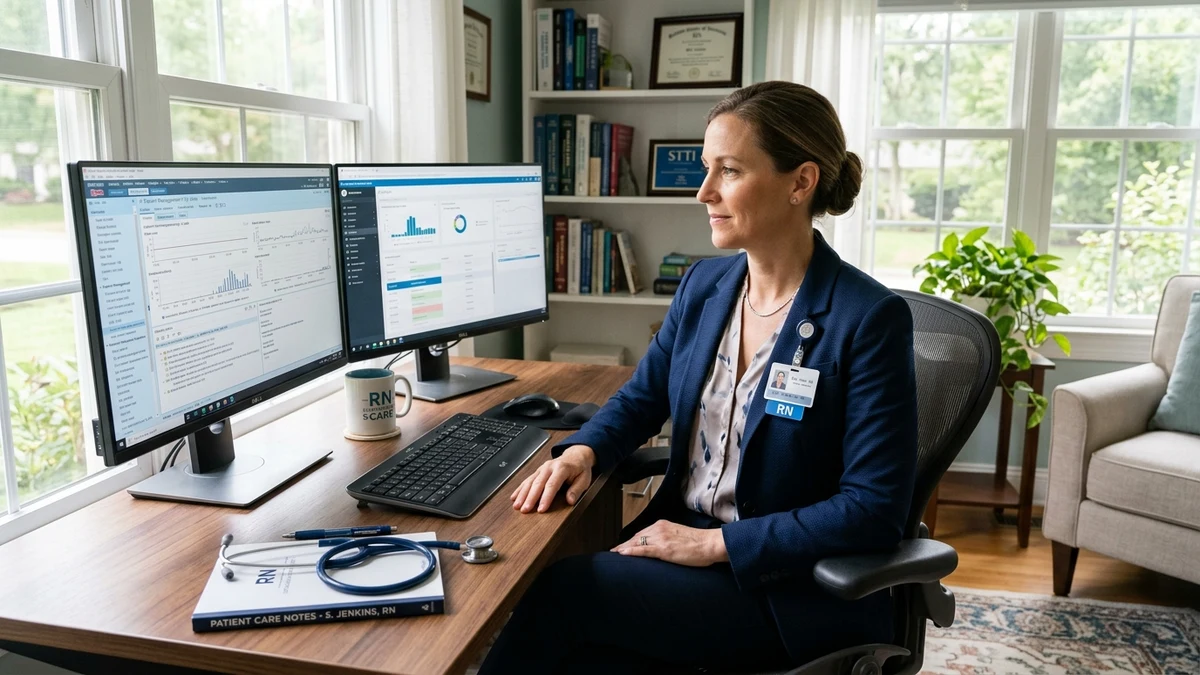
Remote nursing jobs are licensed clinical roles that allow Registered Nurses (RNs) to deliver care management, telephone triage, utilization review, and clinical documentation analysis from a home office. These positions require an active unencumbered nursing license, multi-state compact (eNLC) eligibility, and typically 2 to 3 years of acute bedside experience.
Evaluate inpatient medical necessity, level of care, and acute admissions using InterQual criteria. Collaborate with hospital case managers and CMS Two-Midnight guidelines.
Audit active hospital admissions daily to certify continued stay days and facilitate step-down transfer planning using Milliman Care Guidelines (MCG).
Perform medical necessity determinations for ambulatory and outpatient surgical procedures under commercial and Medicare Advantage plans.
Investigate member and provider denial appeals. Synthesize medical records and clinical criteria to construct peer review denial overturn dossiers.
Dedicated California inpatient utilization management. Conduct concurrent reviews for Kaiser regional hospitals across Northern and Southern CA.
Conduct acute weekend admissions and emergent observation authorization reviews. 10-hour shifts with premium differential.
Authorize prior authorization and acute inpatient admissions for state Medicaid beneficiaries according to Florida Agency for Health Care Administration (AHCA) mandates.
The transition from hospital bedside nursing to a telephonic or digital clinical environment represents one of the fastest-growing professional movements in modern healthcare. Over 62% of inpatient hospital nurses report severe emotional exhaustion and chronic fatigue from unsafe nurse-to-patient ratios, heavy physical lifting, and rotating night shifts. For these licensed professionals, securing a legitimate work-from-home position provides an essential pathway to sustain their clinical career while reclaiming personal autonomy.
However, finding authentic remote roles requires navigating complex state regulatory mandates and avoiding high-volume recruitment scams that prey on burnt-out healthcare workers. Understanding how multi-state licensure operates and learning to audit potential employers ensures a smooth, secure transition into corporate healthcare operations.
Under National Council of State Boards of Nursing (NCSBN) statutes, clinical nursing care legally occurs where the patient is located, not where the nurse sits. The Enhanced Nurse Licensure Compact (eNLC) permits a Registered Nurse residing in one of the 41+ participating member states to practice telephonically or virtually across all other member jurisdictions on a single multi-state license.
To maintain eNLC multi-state privileges, your Primary State of Residence (PSOR) must be an enacted compact state. If you relocate or hold a license in a non-compact jurisdiction (such as California or New York), you must obtain individual state board endorsements to care for patients residing in those regions. Explore our State-by-State Licensure Compact Reciprocity Guide to verify your home state eligibility.
The surge in remote healthcare recruitment has attracted sophisticated employment scams. Fraudulent operators frequently impersonate major payors, offering unsolicited remote triage positions paying above-market hourly rates. Legitimate healthcare organizations adhere to strict vetting standards:
Every listed employer is pre-verified against state nursing board registries, Department of Labor corporate filings, and accredited enterprise applicant tracking systems (Workday, Greenhouse, Taleo) with 100% free un-gated access.
Corporate healthcare payors, health tech providers, and hospital networks hire Registered Nurses across several specialized non-bedside disciplines. Each specialty leverages distinct bedside competencies, translating patient care experience into structured corporate workflows. Review our Non-Bedside Specialty Career Paths for detailed transition strategies.
Utilization Review nurses audit inpatient medical charts against standardized clinical criteria (McKesson InterQual and Milliman Care Guidelines / MCG). Working on behalf of commercial health plans or hospital case management departments, UR nurses evaluate medical necessity, certify level of care, and ensure compliance with the CMS Two-Midnight Rule (42 CFR § 412.3).
Telehealth triage RNs conduct remote symptom assessments for outpatient physician networks, commercial insurers, and health systems. Utilizing validated Schmitt-Thompson clinical algorithms, triage nurses guide callers to appropriate care levels—ranging from home symptom management to urgent emergency department evaluation.
CDI specialists review patient medical records in real time to substantiate diagnostic specificity under ICD-10-CM coding standards. By clarifying physician clinical notes, CDI nurses ensure accurate hospital reimbursement and patient risk-adjustment scoring. HEDIS auditors review charts annually for NCQA preventive quality measures.
Maintaining a compliant home clinical environment is governed by federal privacy laws under the Health Insurance Portability and Accountability Act (HIPAA) Security Rule (45 CFR Part 160 and Part 164). Home health offices require physical and digital isolation to prevent unauthorized exposure of electronic protected health information (ePHI):
Dedicated hardwired Cat6 Ethernet connection with minimum 50 Mbps download / 15 Mbps upload bandwidth. Wi-Fi connections are frequently barred by health plan compliance officers to prevent latency drops during telephonic triage.
Dual calibrated diagnostic monitors (minimum 24-inch 1080p or single 34-inch ultrawide) allowing simultaneous viewing of electronic health records (EHR) and clinical guideline software.
Dedicated private study with a solid-core lockable door and USB noise-canceling binaural headset certified for VoIP communications, preventing ambient family or household sound intrusion.
Ready to calculate your net financial savings from working at home? Use our Remote Net Take-Home Pay & Commute Savings Calculator to evaluate your 90-day transition timeline.
Most employers require an active, unencumbered Registered Nurse (RN) license, an Associate Degree in Nursing (ADN) or Bachelor of Science in Nursing (BSN), and a minimum of 2 to 3 years of acute clinical bedside experience. Specific corporate roles like Utilization Review frequently prefer familiarity with InterQual or MCG criteria, while Case Management positions prioritize Certified Case Manager (CCM) credentials.
Holding an Enhanced Nurse Licensure Compact (eNLC) multi-state license significantly expands your eligibility, granting practice privileges across 41+ participating compact states. However, nurses licensed in non-compact states (such as California, New York, or Illinois) can still secure remote positions specifically dedicated to patients or health plans within their home state.
Under 45 CFR § 164.530(c), healthcare employers require a dedicated, private home office with a lockable door, hardwired high-speed Cat6 Ethernet (Wi-Fi is often restricted due to latency and encryption risks), and sound isolation to protect electronic protected health information (ePHI). Employers typically issue secure corporate laptops with encrypted VPNs and VoIP headsets.
Legitimate remote clinical employers never conduct job interviews via WhatsApp or Telegram, never use generic Gmail or Yahoo email addresses, and never issue checks to purchase home office hardware. Genuine openings route directly to accredited enterprise Applicant Tracking Systems (ATS) such as Workday, Greenhouse, or Taleo under verifiable corporate domains like UnitedHealth Group, Elevance Health, or Humana.
Yes. National Bureau of Labor Statistics (BLS) data indicates that median RN salaries average $86,070 annually ($41.38/hr). While hospital bedside positions may offer evening or night shift differentials, remote corporate nurses save between $5,500 and $8,200 annually in vehicle commute expenses (IRS $0.67/mile), hospital parking, uniforms, and meals, often yielding higher net take-home cashflow.